fbpx

Vibration Plate Core Exercises For Abs, Stomach And Total-body Strength

Written by: Hypervibe Team, Published on: February 11, 2026

Core exercises done on a Vibration Plate—like Planks, V-sits, and Mountain Climbers—increase muscle activation through Whole Body Vibration (WBV).

They’re suitable for most people who rely on Vibration Training at home, older, fit adults who want to push their limes safely, and gym-goers looking to intensify short sessions.

Instead of simple crunches, Vibration training for the core encourages comprehensive muscle engagement, recruiting the deep abdominal muscles, the low back muscles, and the lateral support muscles that help maintain posture, spinal stability, and everyday movement.

If you’ve ever wondered how to work abs and core muscles on a Vibration Plate without overdoing it, this approach focuses on safe positions, controlled effort, and consistency.

Contents hide

Do Vibration Plate Core Exercises Really Work?

Yes.

Vibration Plate core exercises can improve core strength, improve low back strength, and support posture when you perform exercises such as v-sits, planks, and mountain climbers at appropriate settings, two to four times per week.

This is not for spot reduction.

That’s a myth with exercise.

Fat loss only occurs when your body is in an overall calorie deficit, supported by consistent movement and nutrition.

You also unlock other benefits; increased bone density, improved muscle strength, enhanced mobility/flexibility, and improved lymphatic function and circulatory system health.

What Vibration Plate Core Workouts Are Good At

  • Higher muscle activation: Whole Body Vibration (WBV) increases involuntary muscle contractions, causing the abs and deep stabilizer muscles to work more consistently than with traditional exercises.
  • Time efficiency: Shorter sessions (10–20 minutes) offer the same benefits as longer ones without vibration (30-40 minutes).
  • Joint-friendly training: Vibration helps loosen tight tissue and increases circulation, making most exercises much safer.

Who Gets the Most Benefit

  • Beginners and home users who need more effective options
  • Busy adults looking for efficient core workouts
  • Older adults who desire postural support, functionality, and total body strength.
  • Post-rehab or deconditioned users (once medically cleared)
  • Gym-goers wanting to mix up their workouts
  • Consistent users of quality Vibration Plates like Hypervibe, where diversity is a must.

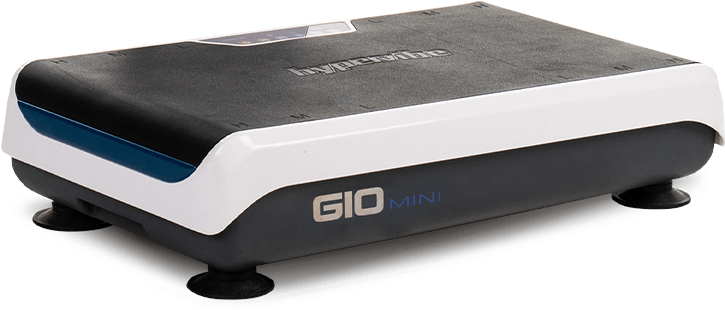
Hypervibe G10 MINI V2
  • icon Reduces Body fat
  • icon Strengthen Muscles, Joints & Bones
  • icon Bluetooth Technology
  • icon 1300+ medical references
A$1,759.00
Shop Now

How Vibration Plate Core Exercises Work

How a Core Session Differs From Static Standing

Standing passively on a Vibration Plate provides less stimulus.

While it can increase circulation and induce muscle activity, it doesn’t sufficiently challenge the core unless you’re more specific with your positioning.

To get results and to understand how to use a Vibration Plate for your abs and other core muscles, you must adopt the right poses.

These positions force your core muscles to resist movement, stabilize joints, and control alignment while the vibration increases muscular demand.

How Often and How Long Should You Train Your Core on a Vibration Plate?

For most users, evidence-aligned Vibration Plate core exercises work best when kept short, focused, and consistent.

You don’t need long sessions—quality beats duration.

Recommended ranges:

  • Frequency: 2–4 sessions per week
  • Time: 10–20 minutes of focused core work per session

This structure provides enough stimulus for muscle activation while allowing proper recovery, especially for beginners and busy adults.

Level Session/weekly Session length Focus
Beginner 2-3 8-12 minutes Pelvic tilts, squats, and planks
Intermediate 3-4 12-15 minutes Squats, glute bridges, Planks, and V-sits
Advanced 3-4 15-20 minutes Glute Bridges, Planks, Side Planks, V-Sits, and Mountain Climbers

Core Exercise Library – Best Exercises by Goal and Body Area

All of the core Vibration Plate exercises below prioritize posture, injury prevention, and progressive muscle engagement.
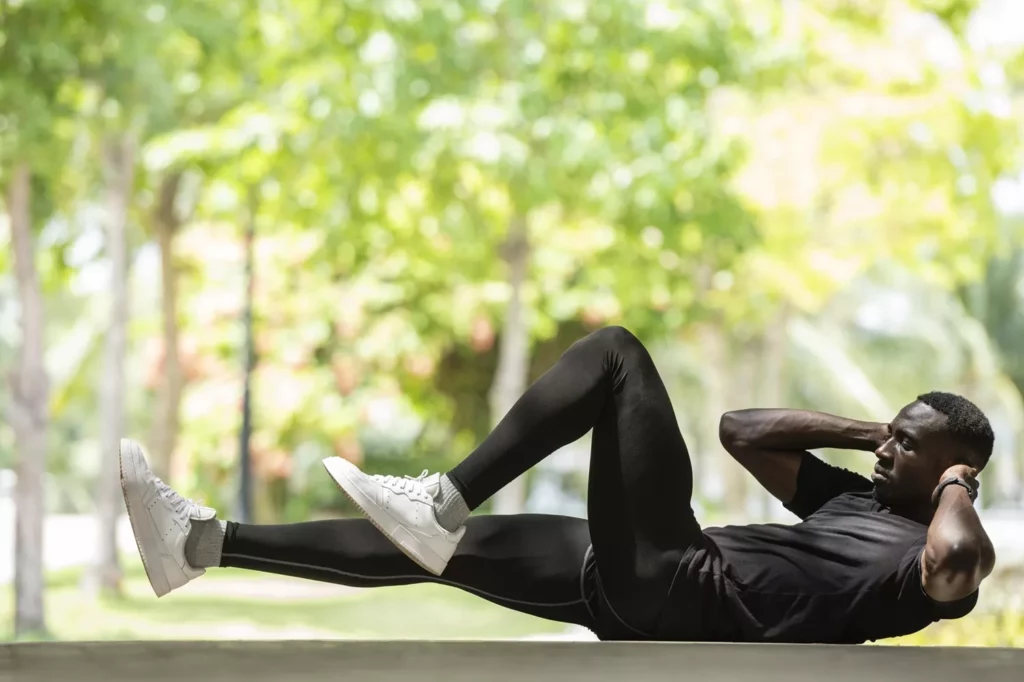
A fit man in athletic wear performing bicycle crunches on the ground in a sunny outdoor park setting.

Outdoor core training: A man focuses on abdominal strength with bicycle crunches.

Beginner and Warm-Up – Standing Pose & Mini Squats

These are some of the best Vibration Plate exercises for people who are short on time and new to using Vibration Plates

  • Standing Pose: Stand tall with knees slightly bent and core gently braced. This activates deep postural muscles and is ideal as a warm-up or recovery move. Add pelvis tilts for an additional challenge.
  • Mini-squat (hold): Hold a shallow squat while bracing your midsection. You should feel your abs and thighs working together.
  • Mini squat (movement): Small, controlled pulses—not bouncing. Great for circulation and core–leg coordination.

Vibration Plate Ab/Core Exercises

These core Vibration Plate exercises increase abdominal demand by adding instability.
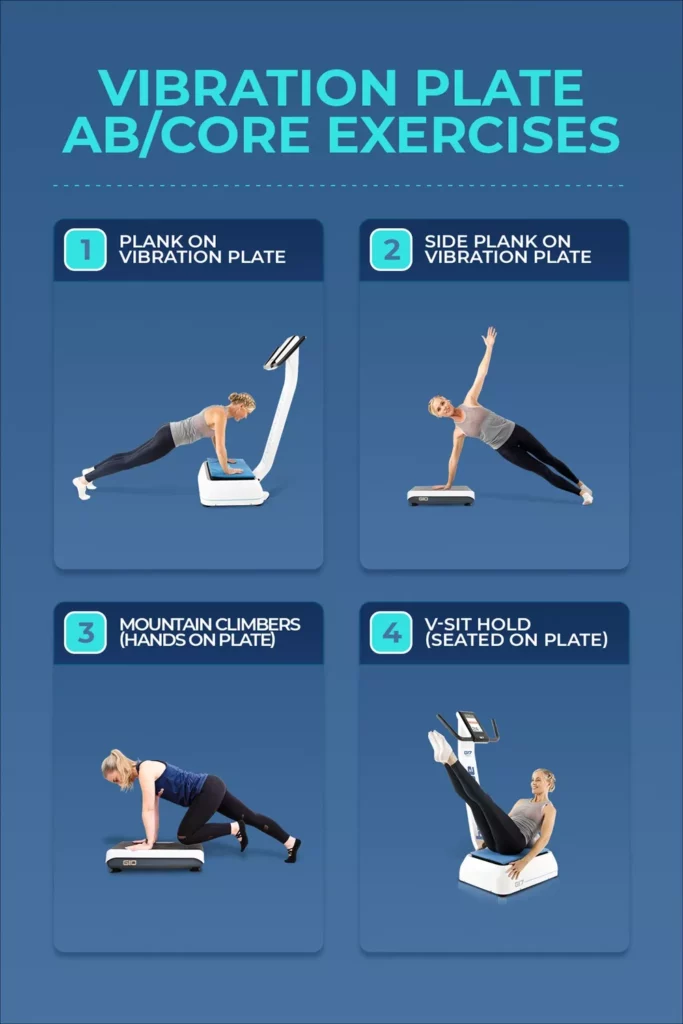
  • Plank on Vibration Plate: Place your hands or forearms on the plate. Keep ears, shoulders, and hips aligned. You should feel your abs and shoulders working evenly. Hold.
  • Side Plank on Vibration Plate: Similar to a plank, but with one arm on the plate and the other on your hip or raised, facing one side. Targets the obliques and lateral core. Keep hips stacked and neck relaxed. Hold.
  • Mountain Climbers (Hands on Plate): Place your hands on the plate and brace your core. Bring one knee towards your chest, return it behind you, and repeat. Move slowly enough to keep hips stable; stop if form collapses.
  • V-Sit Hold (Seated on Plate): Sit directly on the vibration plate with your torso slightly reclined. Lift both feet and hands off the plate, brace your core, and balance on your sit bones. Keep your chest open and spine long and avoid rounding your back.
A chart showing four core exercises on a vibration plate: plank, side plank, mountain climbers, and V-sit hold.

Four essential ab and core exercises optimized for use with a vibration plate.

Alternative Stomach/Tummy-Focused Exercises

These moves bias the front of the core while avoiding common mistakes like neck pulling or excessive hip flexor dominance.

  • Short-Range Crunch Hold: Heels on the plate, ribs down. Raise up into a crunch position slightly—don’t curl or pull the neck.
  • Standing Core Brace with Exhale: Stand tall on the plate with soft knees. Tighten the abs by drawing the navel in. Hold tight while breathing normally.

Love Handle & Oblique Exercises

  • Standing Rotation (Small Range): Stand tall on the plate and brace. Rotate gently from the ribs, keeping hips facing forward.
  • Side Bend Hold (One Hand on Plate): One hand on the plate, body tall. Lean slightly and hold—don’t collapse into the hip.
  • Suitcase Carry (On Plate): Hold a weight in one hand while standing on the plate. Stay upright and resist leaning.

Pelvic Floor–Friendly Deep Core Exercises

These core Vibration Plate exercises are intentionally gentle and suitable for older adults or anyone rebuilding pelvic floor strength.

  • Standing Core Brace with Exhale: Stand tall on the plate with soft knees. Tighten the abs by drawing the navel in. Hold tight while breathing normally.
  • Squats: Hold support if needed. Squat slowly with control.
  • Kneeling Brace: Kneel on the plate with a pad under your knees. Brace the core, hold, and breathe steadily.

Back-of-Core: Vibration Plate Back Exercises & Glute Support

A strong core includes the muscles that support your spine.

  • Glute Bridge (Feet on Plate): Heels on the plate, ribs down. Lift hips and keep them level.
  • Hip Hinge / Romanian Deadlift: Stand tall and hinge at the hips. Keep the spine neutral and the core braced.

How to Choose the Right Exercises

  • Start with standing and mini-squats if you’re new.
  • Progress to harder exercises as tolerated.
  • Use short sets (30–45 seconds) and focus on stability and alignment.
  • Train two to four times per week for best results.

How to Design a 10–15 Minute Vibration Plate Core Workout That Fits Your Level

General Framework

  • Warm-up → four to six moves → cool-down
  • Work for 30–45 seconds per move, rest briefly, and complete one to three rounds depending on your experience and tolerance. Short, focused sessions work best on a Vibration Plate.

Beginner 10-Minute Joint-Friendly Core Routine  – 20-30 secs per exercise

This is designed for first-time users, people living with pain sensitivity, and anyone rebuilding confidence.

Keep frequency low, movements controlled, and breathing steady.
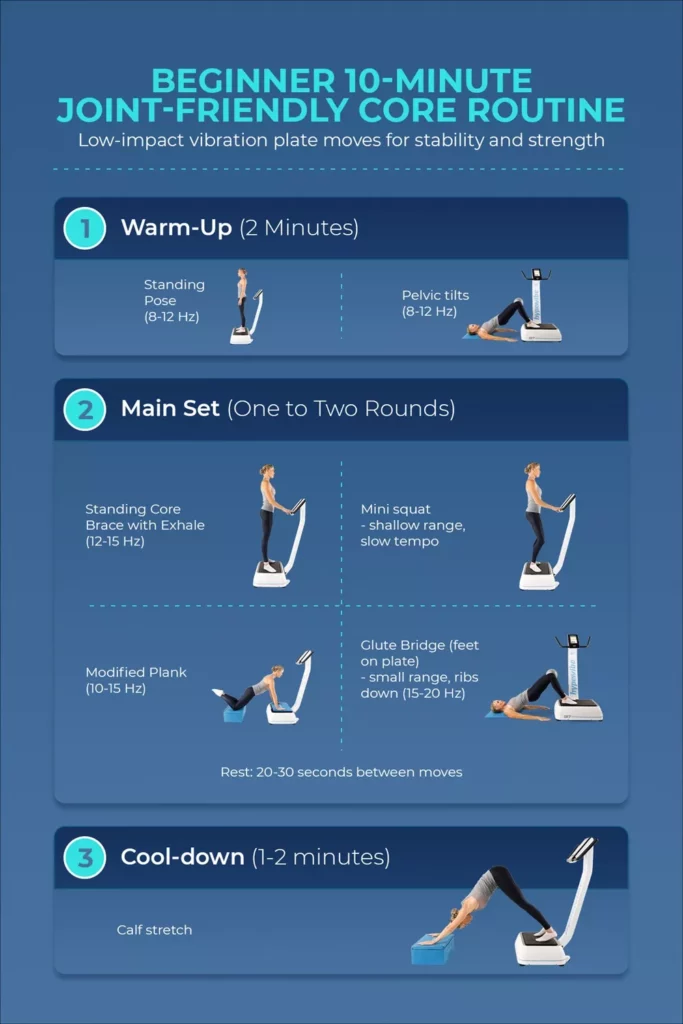
A three-step infographic for a 10-minute beginner joint-friendly core routine using a vibration plate, including warm-up, main set, and cool-down exercises.

Beginner-friendly 10-minute core routine designed for stability and strength using low-impact vibration plate movements.

Warm-Up (2 Minutes)

  • Standing Pose (8–12 Hz)
  • Pelvic tilts (8-12 Hz)

Main Set (One to Two Rounds)  

  • Standing Core Brace with Exhale (12-15 Hz)
  • Mini squat – shallow range, slow tempo (15-20 Hz)
  • Modified Plank – (10–15 Hz)
  • Glute Bridge (feet on plate) – small range, ribs down (15-20 Hz)

Rest: 20–30 seconds between moves

Cool-down (1–2 minutes)

  • Calf stretch, hamstring stretch, slow breathing

Intermediate 15-Minute Core and Legs Routine – 30-45 secs per exercise

This routine balances core stability and lower-body strength for people who have busy schedules and want results without long workouts.

Warm-Up (2–3 Minutes)  

  • Mini Squats (12–15 Hz)

Circuit (2 Rounds)  

  • Pelvic Tilts (15–20 Hz)
  • Hip hinge / Romanian-style deadlift – neutral spine (15–20 Hz)
  • Plank (hands or elbows on plate) – knees down or full plank (15–20 Hz)
  • V-Sits – hold (15–20 Hz)
  • Glute Bridges (15-20 Hz)

Rest: 20 seconds between exercises

This structure keeps heart rate up, reinforces posture, and fits neatly into a lunch break.

Advanced Power-Core Finisher for Physically Fit Users – 45-60 secs per exercise

For experienced users who already tolerate vibration well and want a short, demanding finisher.

An advanced four-step core finisher routine on a vibration plate for physically fit users, featuring high-frequency settings.

High-intensity “Power-Core Finisher” routine for advanced vibration plate users.

Finisher Circuit (1–2 Rounds)  

  • Plank with alternating arm reach (20–30 Hz)
  • Mountain climbers (hands on plate) – controlled hips (20–30 Hz)
  • Single-leg squat or split squat – supported if needed (20–25 Hz)
  • Side plank on plate – short, high-quality holds (20–25 Hz)

Rest: 15–20 seconds between moves

How to Progress Safely

  • Increase one metric at a time (time, intensity etc.)
  • Keep entire sessions under 20 minutes.
  • Maintain a neutral spine, controlled motion, and steady breathing.
  • Train two to four times per week for best results.

Simple Regressions if Needed

  • If your knees feel sore, reduce squat depth or switch to heel raises.
  • If your lower back feels tight, stop and return to gentler exercises.
  • If you feel dizzy or severe pain, discontinue.

Stable, well-engineered platforms like Hypervibe make progression easier by offering predictable vibration and solid footing, which supports proper technique.

What to Expect in 4, 8, and 12 Weeks

Here’s what most users notice when they train consistently two to four times per week.
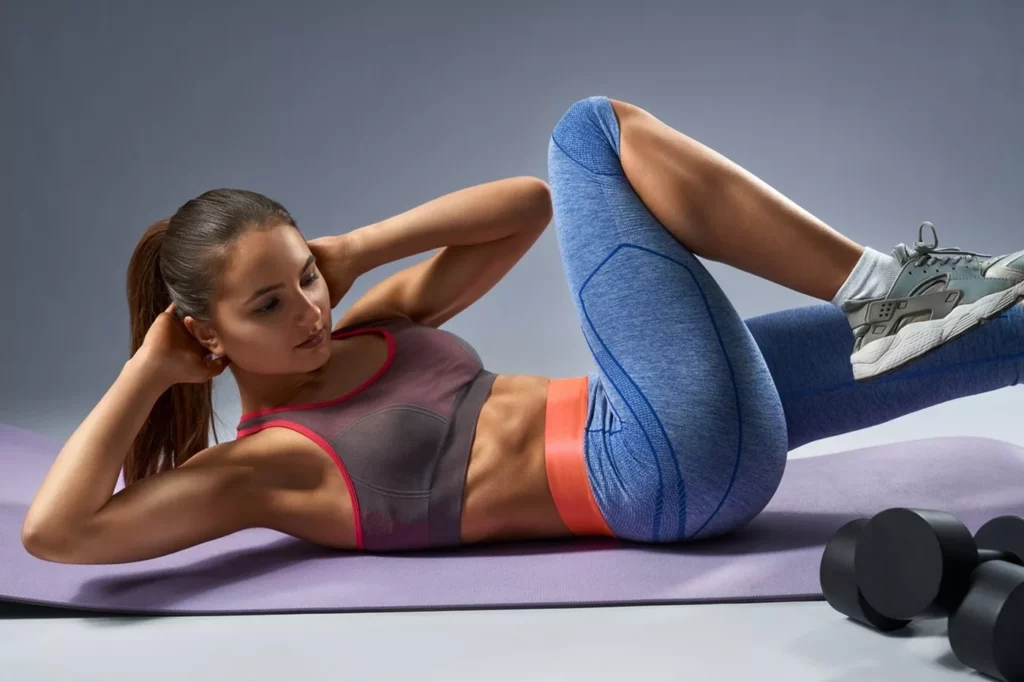
A woman in blue leggings and a sports bra performing bicycle crunches on a purple yoga mat.

Targeted abdominal workout: An athlete demonstrates proper bicycle crunch form.

After 4 Weeks

  • Better stability around the midsection
  • Improved core awareness and posture
  • Less stiffness and less discomfort
  • Exercises feel easier

After 8 Weeks

  • Noticeable gains in core strength
  • Harder exercises are less challenging
  • Waist area feels firmer; clothes may fit slightly looser
  • Better confidence with advanced movements and other forms of training

After 12 Weeks

  • Clear improvements in core strength and control
  • Visible changes in waist measurement or muscle definition (when paired with cardio and diet)
  • Stronger posture habits that carry into daily life and more enthusiasm about fitness

How to Track Progress (Keep It Simple)

  • Photos: front and side, same lighting, every four weeks
  • Clothing fit: waistbands, belts, how tops sit
  • Simple tests: plank hold time, single-leg balance (eyes open), squat depth comfort

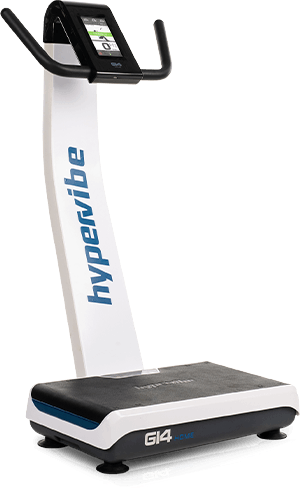
Hypervibe G14 Home V3
  • icon Reduces Body Fat
  • icon Strengthen Muscles, Joints & Bones
  • icon WIFI
  • icon 40 x Therapist Designed Programs
A$3,969.00
Shop Now

Safety First – Protecting Your Back, Knees, and Pelvic Floor

Back-Friendly Vibration Plate Core Work

Used correctly, Vibration Plate core exercises can be back-friendly.

Used poorly, they can aggravate existing issues.

The difference comes down to spine position, load, and intent.

Key Cues for a Neutral Spine

  • Squats: Keep ribs stacked over hips, chest tall, knees soft. Brace your core as if gently tightening a belt.
  • Hip hinges: Hinge from the hips, not the lower back. Maintain a long spine from head to tailbone.
  • Planks: Keep ears, shoulders, and hips in one line. Light brace, steady breathing, no sagging or arching.

Stop immediately and seek professional advice if you feel:

  • Sharp or worsening pain
  • Tingling or numbness
  • Shooting pain down one or both legs
  • Loss of strength or coordination

Warning: Never lie with your stomach directly on the vibration plate.

Contraindications

According to clinical insights and leading fitness studies, Vibration Training should be avoided by individuals with a number of conditions.

The most common ones are:

  • Pregnancy (especially during the first trimester)
  • Pacemakers or implanted devices
  • Severe cardiovascular conditions
  • Acute hernias or fresh surgical wounds
  • Severe diabetes with neuropathy
  • Epilepsy or uncontrolled migraines
  • Any active blood clotting disorder

If you’re unsure, speak with your healthcare provider before starting a Vibration Training program.

How Vibration Plate Core Work Fits With Your Other Training

Where to Put Core Sessions in Your Week

You don’t need daily core training.

Two to four focused sessions per week is enough when vibration is used intentionally.

Weight-Loss Focus

Goal: calorie-burn support, posture, consistency

Sample week:

  • Mon: Vibration Plate core workout (10–15 minutes) and a walk
  • Wed: Cardio (walking or cycling)
  • Fri: Vibration Plate core and legs (10–15 minutes)
  • Weekend: Optional light cardio or mobility

Back-Health Focus

Goal: spinal support, posture, pain-aware progress

Sample week:

  • Mon/Thurs: Vibration Plate core (anti-flexion, hinge focus)
  • Wed/Fri: Yoga or other flexibility work
  • Daily: Walking

Better Performance Focus

Goal: strength training, stability under load

Sample week:

  • Mon: Strength training and traditional core work
  • Tues/Fri: Vibration Plate core training
  • Thurs: Strength training and cardio
  • Optional: Short vibration recovery session

Choosing the Right Vibration Plate

Many entry-level or generic plates look similar on the surface, but their specs limit how well you can progress core training safely and effectively.
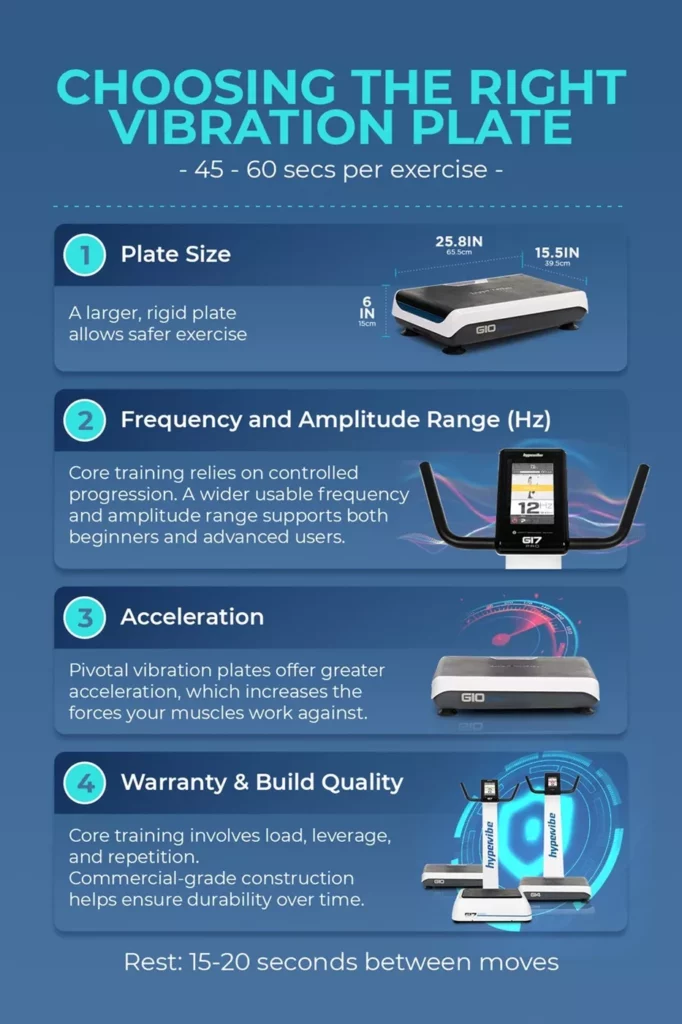
An infographic detailing four key factors for choosing a vibration plate: plate size, frequency range, acceleration, and build quality.

Key considerations for selecting the right vibration plate for effective core training and durability.

Specs That Are Important for Core and General Training

When comparing a core Vibration Plate, these features are key:

  • Plate Size: A larger, rigid plate allows safer exercise
  • Frequency and Amplitude Range (Hz): Core training relies on controlled progression. A wider usable frequency and amplitude range supports both beginners and advanced users.
  • Acceleration: Pivotal vibration plates offer greater acceleration, which increases the forces your muscles work against.
  • Warranty & Build Quality: Core training involves load, leverage, and repetition. Commercial-grade construction helps ensure durability over time.

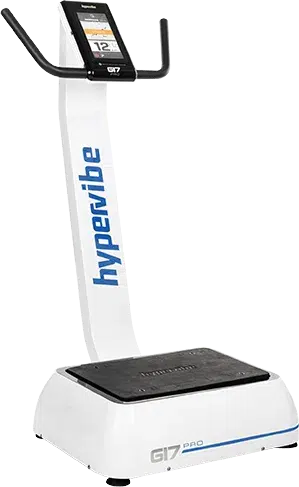
Hypervibe G17 Pro V2
  • icon Reduces Body Fat
  • icon Strengthen Muscles, Joints & Bones
  • icon WIFI
  • icon 40 x Therapist Designed Programs
A$5,699.00
Shop Now

How Hypervibe Plates Support Progression Better Than Generic Machines

Generic Vibration Plates often top out quickly: users outgrow the usable frequency range or experience instability before their core actually adapts.

By contrast, Hypervibe plates are designed around progressive neuromuscular loading.

What that looks like in practice:

  • Broad frequency headroom so users can progress gradually rather than jumping intensity
  • Stable pivotal vibration that supports planks, squats, hinges, and coordination drills
  • Guided app-based workouts and evidence-aligned protocols that reduce guesswork

On a Hypervibe G-Series plate, a user might begin core work at lower frequencies focused on posture and bracing,

then progress into higher-frequency ranges as their stabilizers adapt without changing machines or compromising form.

That progression simply isn’t possible on many entry-level plates.

FAQs
- Does a Vibration Plate strengthen your core, or is it just a gimmick? +

Yes, Vibration Plates can strengthen your core when you use active positions like squats, planks, v-sits, and mountain climbers  

Whole Body Vibration increases muscle activation, especially in stabilisers, making short, focused core sessions more effective than floor work alone.

- Do Vibration Plates work if you just stand on them? +

Standing poses do provide benefits, such as circulation, muscle strengthening, and postural awareness.

Bigger core strength gains come from integrating traditional exercises with the plate.

- How often should I use a Vibration Plate for abs, stomach, and core? +

Most people get the best results with two to four sessions per week, lasting 10–20 minutes each.

This frequency allows muscles to adapt while avoiding overuse, especially when vibration is combined with walking or traditional cardio activities.

- Is it safe to use a Vibration Plate if I have back pain or past injuries? +

It can be safe, but only with slow progressions, safe spine positioning, and medical clearance when needed.  

If you feel sharp pain, tingling, or symptoms that worsen, stop and consult a physio or healthcare professional before continuing.

- Can Vibration Plate exercises help my pelvic floor or make it worse? +

They can help.

Start with upright, supported positions; avoid breath-holding; and seek guidance if you have prolapse, are postpartum, or recently had surgery.

- Can I lie on my stomach on a Vibration Plate? +

No—lying directly on your stomach on a Vibration Plate is not recommended.

This position can place unnecessary pressure on the spine and abdominal organs.

- What is the best stance on a Vibration Plate to work my core while standing? +

The best stance is a soft-knee, upright position with a gentle abdominal brace and a neutral spine. 

Add pelvic tilts to engage the core further.

From there, progress to shallow squats, mountain climbers, or planks

- Do I need a special Vibration Plate for serious core training? +

Yes.

Plate stability, frequency range, and vibration quality are important for core work.

Well-engineered platforms like Hypervibe support safer progression and controlled core activation compared to entry-level or generic machines.


Get a summary in:

Top Posts

Learn more about
the benefits of using vibration therapy and our G series vibrations machines.
0
Your Cart