The best frequency setting for a vibration plate (whole body vibration platform) depends entirely on your health goals. Generally, 20–40 Hz is ideal for weight loss, muscle toning, and strength-building. 10–20 Hz is recommended for exercise recovery, lymphatic drainage, and soft tissue relaxation. And when it comes to bone health, numerous frequencies between 15-40 Hz are scientifically validated.
Of course, other factors such as age, gender, fitness level, and health conditions contribute to determining the optimal frequency for a specific individual.
Another reason that frequency is important is because, when combined with amplitude (how far the plate moves while it’s vibrating), it determines the resistance force your body must work against—referred to as the G-force.
Through years of clinical research analysis and engineering our own industry-leading machines at HyperVibe, we’ve decoded exactly how the human body responds to specific mechanical vibration frequencies.
This guide cuts through the noise and the misleading “speed settings” on low-cost machines to give you a precise frequency roadmap backed by peer-reviewed science.
|
Health Goal |
Ideal Hz Range |
Recommended Session Length |
|
Weight Loss & Fat Burning |
20–40 Hz |
15–20 min |
|
Muscle Toning & Strength |
20–40 Hz |
10–20 min |
|
Bone Health & Osteoporosis |
15–3 Hz |
10–20 min |
|
Lymphatic Drainage & Circulation |
10–30 Hz |
10–20 min |
|
Exercise Recovery & Soft Tissue Relaxation |
Below 20 Hz |
5–15 min |
The information given in this table is an average of frequencies that were used in effective Whole Body Vibration (WBV) research studies.
If you’ve ever stepped on a low-cost vibration plate and tried to find the best setting, you’ve likely faced a confusing number. A speed setting that’s somewhere between 1 and 99. Don’t mistake speed for frequency.
Hertz (Hz) is the universal, objective measure of frequency. It tells you exactly how many times the plate completes one full cycle of movement per second. If a plate operates at 20 Hz, it is moving up and down 20 times per second. This is the accurate measure used in biomechanics research and clinical studies.
Speed levels, by contrast, are a gimmick. Each manufacturer divides their machine’s actual Hz range into however many increments they choose. Manufacturer A may take a 15 Hz machine and program the machine to adjust 1/10th of a Hz at a time. Now, you have 150 speeds, which makes the platform appear to be superior.
The result is a marketplace full of products that look impressive on a spec sheet but cannot deliver the full range of therapeutic effects.
To understand why one machine produces results and another may not, you need to understand how the three variables mentioned earlier work together:
When you increase frequency without maintaining sufficient amplitude, the plate’s movements become so rapid and shallow that your muscles never receive a proper stretch signal. It feels like a buzzing or tingling sensation rather than a muscular contraction.
When you increase amplitude without maintaining sufficient frequency, the plate becomes a massager. It will loosen you up, but there’s no real resistance.
Research tracking vibration transmission through the body confirms that beyond 40 Hz, the vibration power transmitted to the ankle, knee, hip, and spine declines dramatically. It declines by a factor of 10 to 1,000 at very high frequencies. Therefore, chasing the highest Hz number possible is not a great strategy either because it actually reduces the effect delivered to your tissues.
The sweet spot is a precise combination of Hz and amplitude that delivers sufficient G-force to stimulate muscle contractions and connective tissue responses without stressing joints or creating the dampening effect of excessively high frequencies.
For metabolic goals that may include fat burning, caloric expenditure, and body composition change, frequencies in the 25–50 Hz range (with sufficient amplitude, and therefore sufficient G-force) are most supported by research.
At these frequencies, the vibration plate triggers rapid, involuntary muscle contractions through the tonic vibration reflex (TVR). When this effect is combined with active exercises on the plate, there’s an increase in overall metabolic demand and oxygen consumption during and after the session.
Research suggests that frequencies between 25–50 Hz are also optimal for muscle strengthening, further creating a system designed to burn fat.
Several dynamic exercises that can be performed on the platform include:
The golden range for focusing specifically on muscle development is 25–50 Hz, with the most extensively studied and clinically validated window sitting between 30 and 45 Hz.
Again, this has a lot to do with the TVR. Let me explain.
Your muscles contain specialized sensory organs called muscle spindles. When the vibration plate stretches a muscle even slightly, the spindle fires an electrical impulse to the spinal cord, which immediately sends a signal back down to the muscle to contract. This is also referred to as “the stretch reflex” and is the same mechanism your doctor tests when they tap your knee with a rubber hammer. On a vibration plate, this cycle repeats 20 to 50 times per second, giving your muscles an intensive workout without requiring you to consciously lift heavy loads.
Clinical research supports a specific approach called Low-Intensity Vibration (LIV), typically delivered in the 25–35 Hz range. This combination is believed to stimulate osteoblast activity (the bone-building cells) without stressing the joints.
Studies specifically examining postmenopausal women have shown that whole-body vibration within this frequency range can support improvements in bone mineral density at the hip and lumbar spine. These are two of the most fracture-vulnerable sites.
A 1-year RCT of 70 postmenopausal women using 30 Hz at 0.2 g confirmed that vibration can curb spinal and femoral bone loss, with effects improving with compliance.
Practical guidance for bone health users:
The lymphatic system has no pump of its own. Unlike the heart driving blood through your arteries, lymph fluid moves only through muscle contractions, breathing, and physical movement.
A vibration plate operating in the 10–30 Hz range (and high enough G-force) provides a rhythmic mechanical pumping action against gravitational forces that mimics the effect of walking, stimulating lymph flow without requiring intense exercise.
At these frequencies, the plate produces enough muscular engagement and tissue compression to move lymph through vessels and nodes, while keeping intensity low enough to avoid over-stimulating an already taxed immune or circulatory system.
A 2016 study found that 30 Hz vibrations delivered for 6–10 minutes increased venous diameter by 7–12%, with researchers noting a positive effect on the superficial lymphatic system.
This frequency band is particularly relevant for people experiencing:
At frequencies below 20 Hz, the mechanical effect on the body shifts. The rapid, high-intensity reflex contractions that characterize the 30–50 Hz therapeutic range give way to a more rhythmic, oscillatory stimulus.
Research has used frequencies up to 30 HZ but has noted that frequencies below 20 Hz induce soft tissue relaxation.
At these lower settings, the body’s parasympathetic nervous system, which is the branch responsible for rest, digestion, and repair, is assumed to be supported. Blood flow to the muscles increases too. The gentle rhythmic pulsing has been compared to the physiological state your nervous system enters as you fall asleep.
Applications for under-20 Hz vibration:
There are two primary platform types you’ll encounter:
These move in a see-saw motion (alternating vertical force). The left side rises as the right side drops, mimicking the natural alternating motion of walking. This design operates most effectively at lower frequencies (typically 5–35 Hz) and produces larger amplitude movements (up to 8 mm).
Because the motion is alternating and follows natural gait mechanics, it is generally considered more functional.
They move directly up and down, like a piston. They typically operate at higher frequencies (25–45 Hz) with lower amplitude (1–3 mm). This design is more effective for upper body training or exercises needing large surfaces.
HyperVibe’s pivotal platform design is intentionally built to exploit the see-saw motion at therapeutic frequencies. Research tracking vibration transmission through the lower body confirms that pivotal oscillation at the right frequency delivers substantial G-forces to the muscles and bones without the joint compression risk associated with purely vertical, high-frequency linear machines.
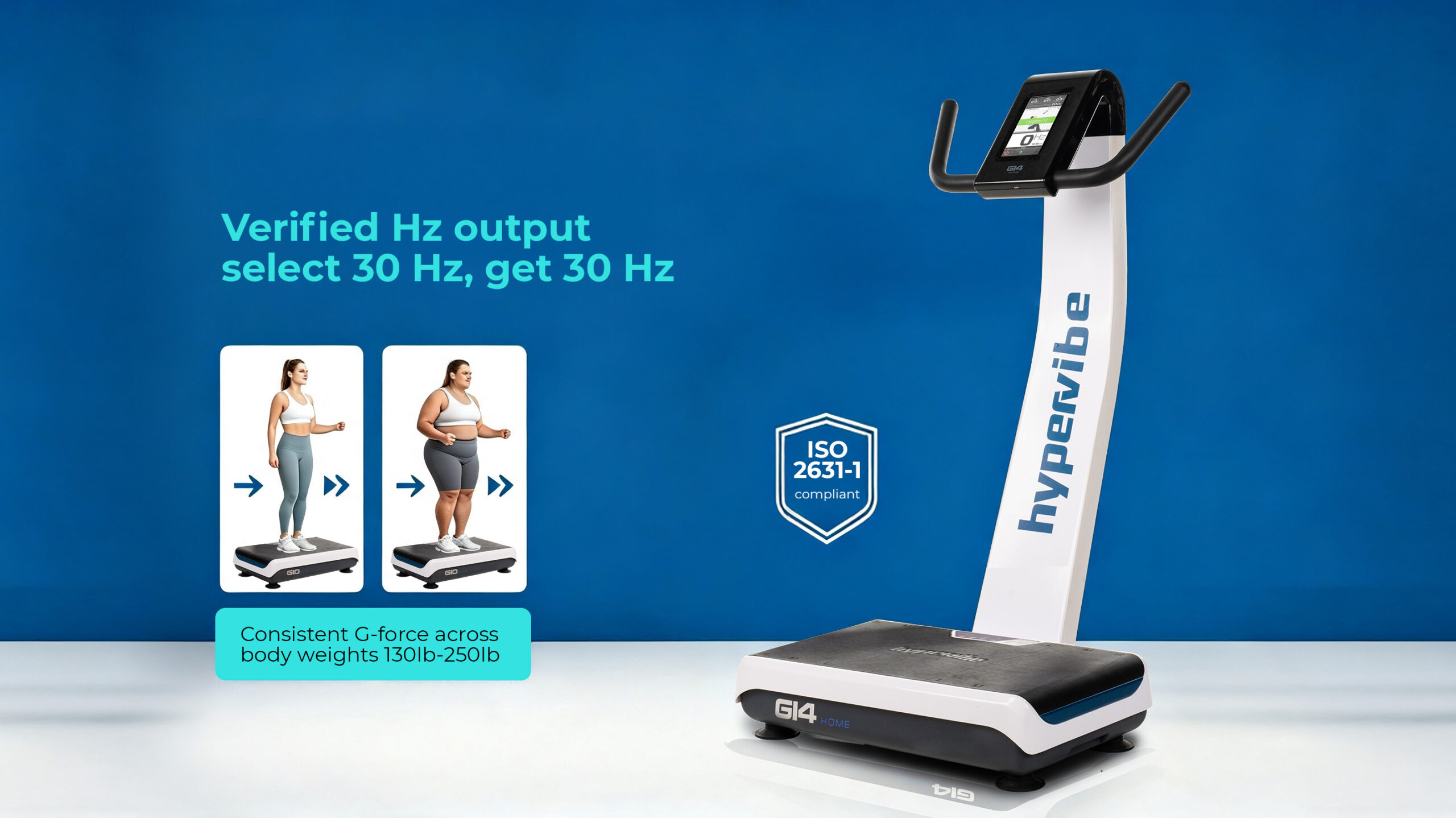
When you select 30 Hz on a HyperVibe machine, you receive 30 Hz. This commitment to verified, accurate frequency output is an engineering standard rooted in clinical science.
HyperVibe machines are designed to comply with ISO 2631-1, the international standard for whole-body vibration measurement and reporting. This means that the amplitude, frequency, and G-force values we publish are independently verified mechanical outputs.
HyperVibe’s G-Series machines are also specifically engineered to maintain consistent output across different user body weights; the platform and motor assembly are built to sustain therapeutic G-forces whether the user weighs 130 lbs or 250 lbs.
The clinically relevant therapeutic spectrum for WBV runs from approximately 5 Hz to 35 Hz. Below 5 Hz, the movement becomes too slow to trigger meaningful physiological responses. Above 35 Hz, vibration dampening through the body’s tissues can reduce the stimulus reaching the muscles and bones to near-negligible levels. For practical purposes, the range from 5 to 35 Hz covers the vast majority of therapeutic applications, from relaxation and lymphatic drainage at the lower end to muscle toning and metabolic activation at the upper end. Used correctly, vibration plates are safe. The most important safety principle is to start low and progress gradually. Begin at lower frequencies (under 20 Hz) for your first few sessions to allow your body to adapt. Overstimulation signs include excessive muscle soreness that persists beyond 48 hours, joint discomfort, headache, or nausea during or after sessions. These typically indicate too-high frequency, too-high amplitude, or sessions that are too long for your current conditioning level.

Here’s how we use a vibration plate for weight loss...
If, a few minutes into your session on the vibration...
Are vibration machines bad for you? Yes, if used incorrectly....
Yes, Vibration Plates or Whole Body Vibration (WBV) platforms, promote...
Most people get the best results using a vibration plate...
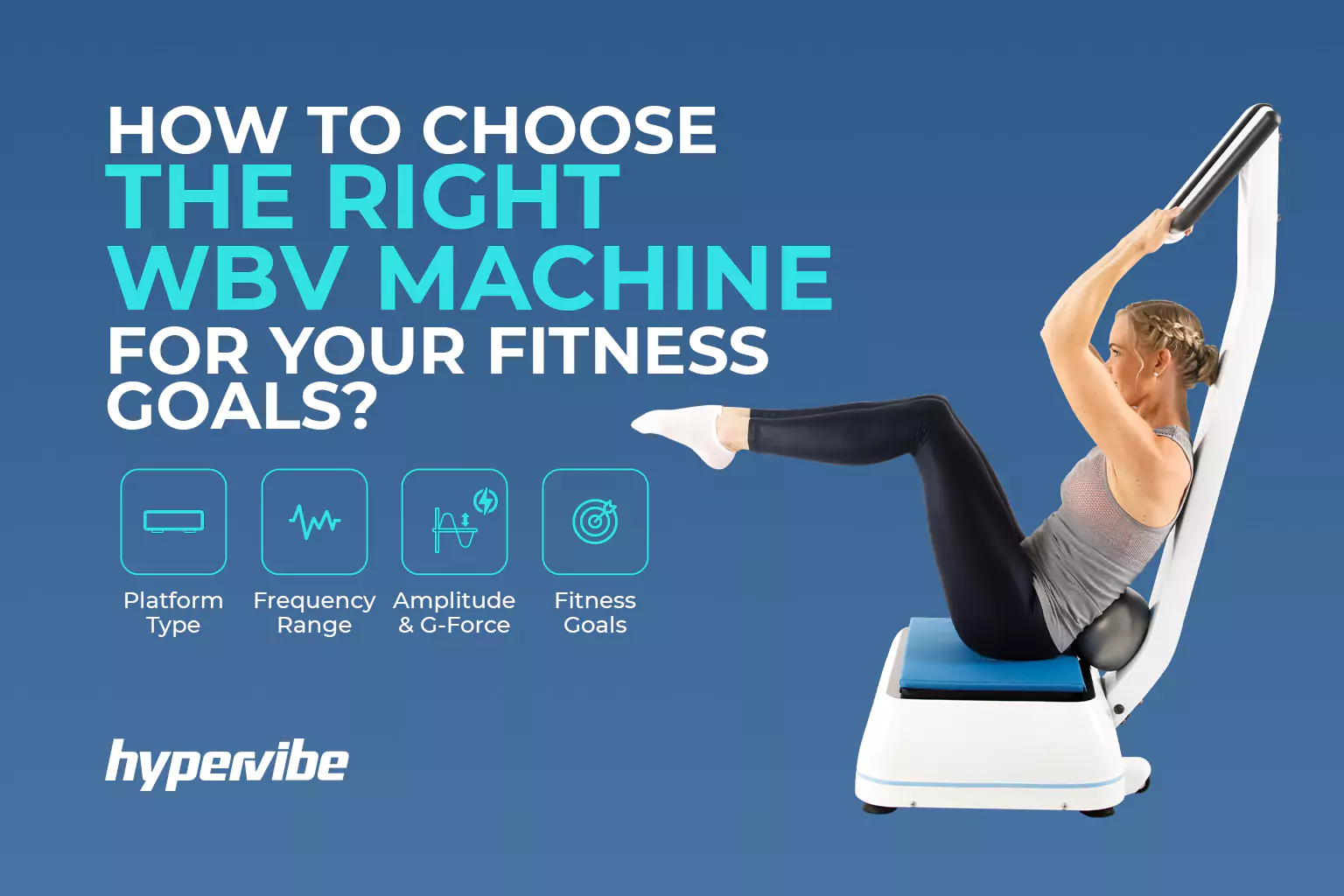
When you are choosing the right Whole Body Vibration (WBV) Machine, also known as a Vibration Plate, there are 5...
We are always looking for a way to boost our fitness, weight loss, or mobility. Vibration Plates might be the...
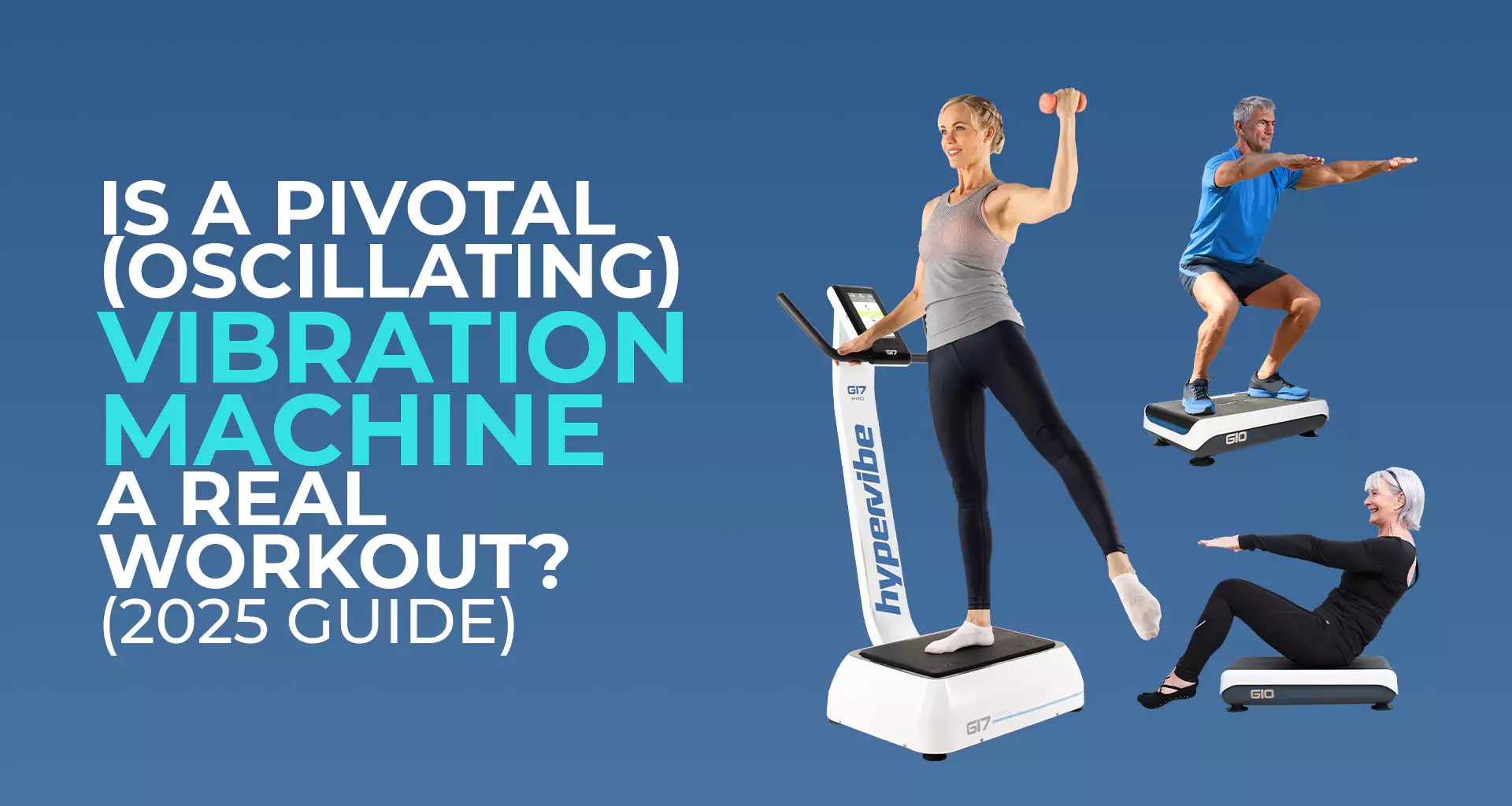
Yes, a Pivotal (Oscillating) Vibration Machine is a real workout. Unlike Lineal (Vertical) Vibration Plates that move straight up and...
Can You Get In Top Shape With a Vibration‑Plate Workouts? Yes. When we put clients on a vibration plate consistently...
Vibration Plates help with anxiety because of the way they calm the nervous system. The vibration felt in the body...
Can athletes benefit from using vibration platforms? Yes. Vibration platforms are scientifically validated performance and recovery tools for athletes. [lwptoc]...
Here’s how we use a vibration plate for weight loss...
If, a few minutes into your session on the vibration...
Are vibration machines bad for you? Yes, if used incorrectly....
Yes, Vibration Plates or Whole Body Vibration (WBV) platforms, promote...
Most people get the best results using a vibration plate...