
£1,032.50
Shop Now
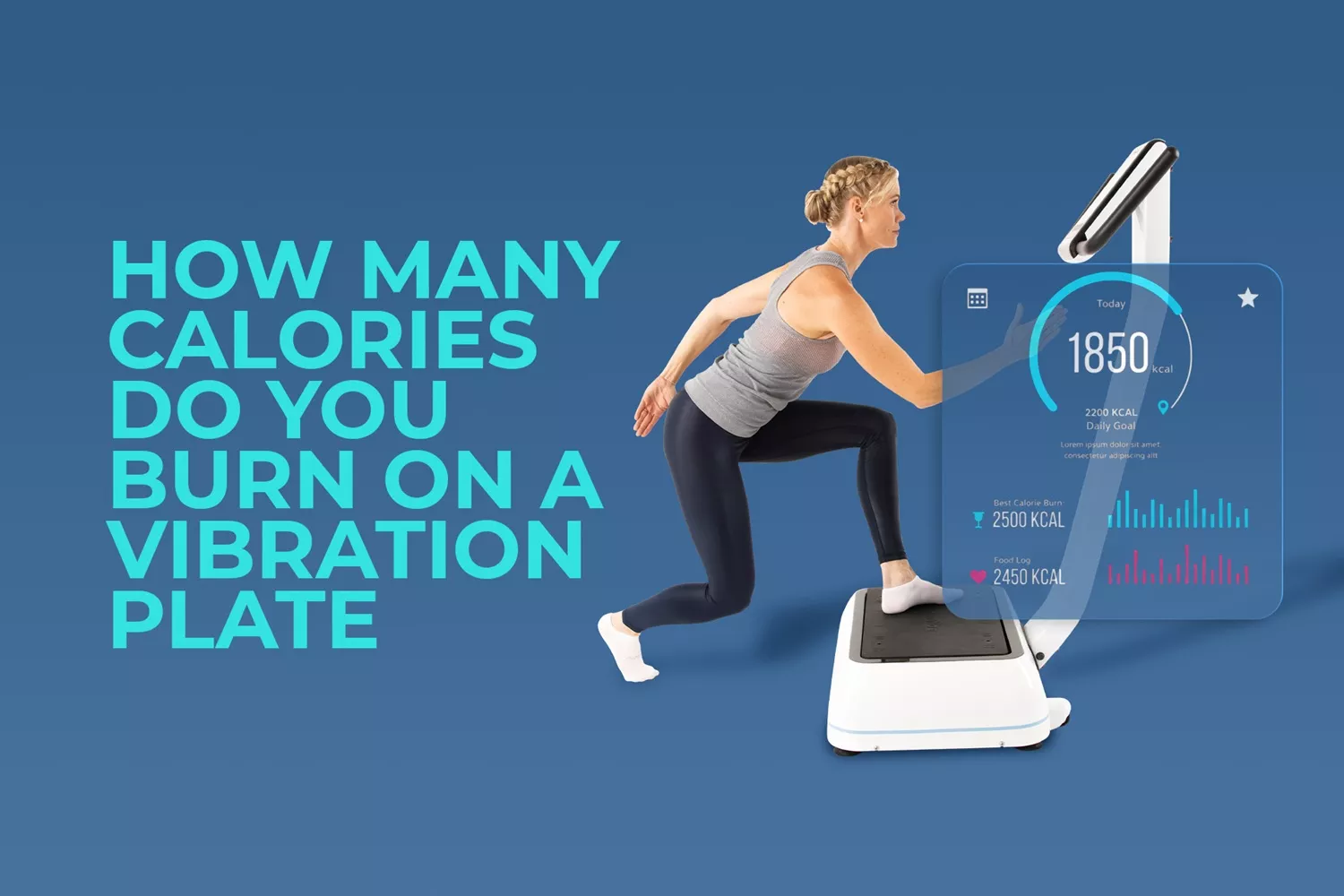
This article breaks down how many calories you can realistically burn when exercising on a Vibration Plate, and what influences those numbers. It’s designed for home users, 50+ adults, busy gym-goers, and trainers who want to set clear expectations.
When we test Hypervibe sessions with real users, the calorie ranges we see are far more grounded than what’s often quoted online. Burn rate depends on what exercises are being performed, session length, the vibration plate’s settings, and whether users rest between exercises.
Exercises with less movement (ex. Standing Pose, Planks etc.) will burn less calories Targeted Vibration Plate exercises such as push-ups, squats, lunges, and tricep dips consistently push calorie expenditure higher by activating more muscle groups at once.
Rather than promising “fast fat loss”, this article explains how Vibration Training fits into everyday weight management and what results are realistic when used consistently alongside healthy movement, well-balanced nutrition, and proper recovery.
Hypervibe G10 MINI V2


 £1,032.50
Shop Now
£1,032.50
Shop Now
The calculator above gives a realistic calorie range based on how you approach Vibration Training.
Your result will differ based on body weight, session length, intensity, and exercises.
It rises significantly when you move from static Vibration Plate exercises to dynamic ones, intended for weight loss.
As mentioned above, these include squats, push-ups, lunges, tricep dips or core exercises including movement.
To make the numbers easier to visualise, we also show how your routine compares to brisk walking or light jogging, using benchmarks aligned with Nutracheck and standard calorie-burn calculators.
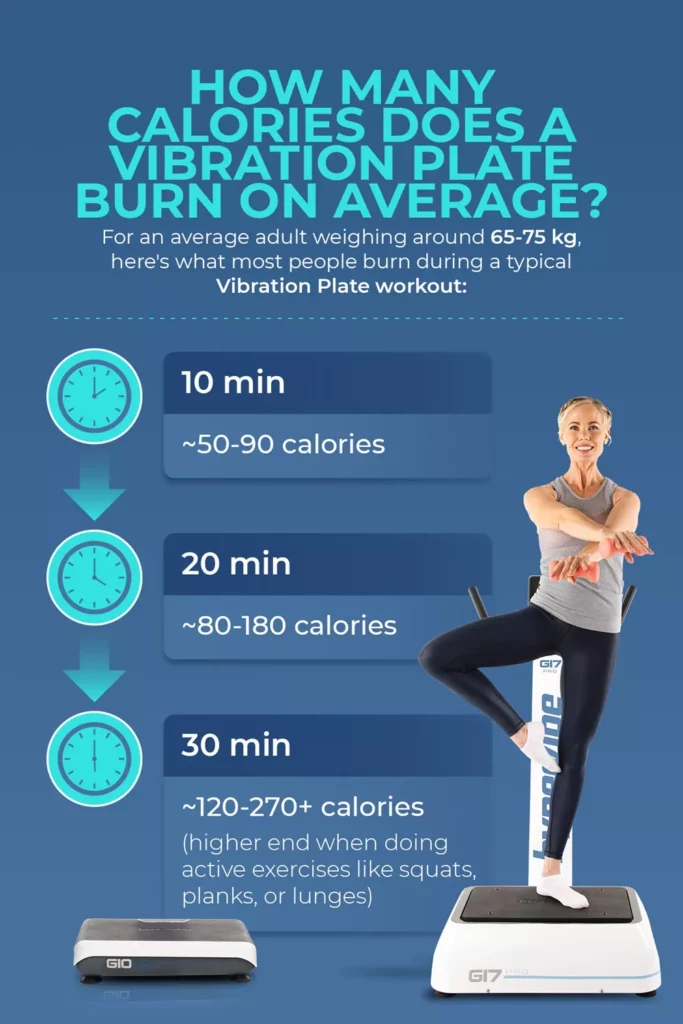
Average calorie burn expectations based on workout duration on a vibration plate.
For an average adult weighing around 65–75 kg, here’s what most people burn during a typical Vibration Plate workout:
These ranges reflect realistic use, combining data from calorie calculators, Vibration Plate exercise benchmarks, and studies referenced by brands like Nutracheck.
Static exercises sit at the lower end, while more dynamic Vibration Plate exercises for weight loss, belly fat, and strengthening push calorie burn toward the top of the range.
For the same amount of time, a low-level Vibration Plate workout burns roughly the same calories as brisk walking or light cycling, with the advantage of being low-impact and joint-friendly—especially useful for beginners, older adults, or people short on time.
With increased intensity, that burn rate goes up, rivaling the average resistance training workout.
Important caveat:
Like with all exercises, these numbers are estimates, not guarantees. Calorie burn takes other variables into account.
Peer-reviewed research and reputable fitness data sources consistently show that Whole Body Vibration (WBV) increases energy expenditure compared with quiet standing.
From a physiological standpoint, Vibration Plates increase calorie burn through two well-documented mechanisms:
Studies measuring oxygen consumption (VO₂) and metabolic equivalents (METs) during WBV sessions show a higher energy cost than standing still, with further increases when vibration is combined with active movements rather than static ones.
This principle underpins how vibration is treated in mainstream calorie-burn calculators.
Yes. Static exercises increase calorie burn, but meaningful results come from exercises with movement.
Depends on what exercises you’re doing on the plate, how intense are the settings, how fast or far you run etc. In general, there is no way to answer this question.
No. Vibration Plates can support weight loss by adding calorie burn and muscle activation, especially when paired with active exercises and consistent weekly use.
When you stand or perform exercises on a vibration plate, the platform places resistance on the body at rapid rates.
This causes fast, involuntary muscle contractions, while your nervous system works additionally to support posture and balance.
Both processes require energy—so calories are burned.
Unlike walking or cycling, vibration training doesn’t rely on long, repetitive movements.
Instead, calorie burn comes from muscle activation and stabilisation effort, which is why results can vary widely between users and sessions.
In simple terms:
This is why vibration plate calorie estimates are always shown as ranges, not fixed numbers.
Experienced trainers focus on short, well-structured sessions with active positions rather than long, static exercises.
For fat loss or conditioning, professionals typically recommend:
The table below combines realistic estimates drawn from vibration-specific calorie benchmarks (e.g. Nutracheck-style MET modeling) and widely used calorie calculators.
| Session Type | Time | 60 kg | 75 kg | 90 kg |
| Low-intensity standing | 10 min | ~20–30 kcal | ~25–40 kcal | ~35–55 kcal |
| 15 min | ~30–45 kcal | ~40–60 kcal | ~55–80 kcal | |
| 20 min | ~40–60 kcal | ~55–85 kcal | ~75–110 kcal | |
| 30 min | ~60–90 kcal | ~80–130 kcal | ~110–160 kcal | |
| Mixed moves (light squats, core holds) | 10 min | ~35–55 kcal | ~45–70 kcal | ~65–95 kcal |
| 15 min | ~55–80 kcal | ~70–110 kcal | ~95–140 kcal | |
| 20 min | ~70–110 kcal | ~95–150 kcal | ~130–190 kcal | |
| 30 min | ~110–160 kcal | ~140–220 kcal | ~190–270+ kcal | |
| Higher-intensity circuit (planks, lunges, intervals) | 10 min | ~50–80 kcal | ~65–100 kcal | ~90–130 kcal |
| 15 min | ~80–120 kcal | ~100–160 kcal | ~135–190 kcal | |
| 20 min | ~100–160 kcal | ~130–200 kcal | ~180–230+ kcal | |
| 30 min | ~150–230 kcal | ~190–270+ kcal | ~240–330+ kcal |
Per-minute calorie burn is simply an average:
Multiply the per-minute rate by total session time to estimate overall calorie burn.
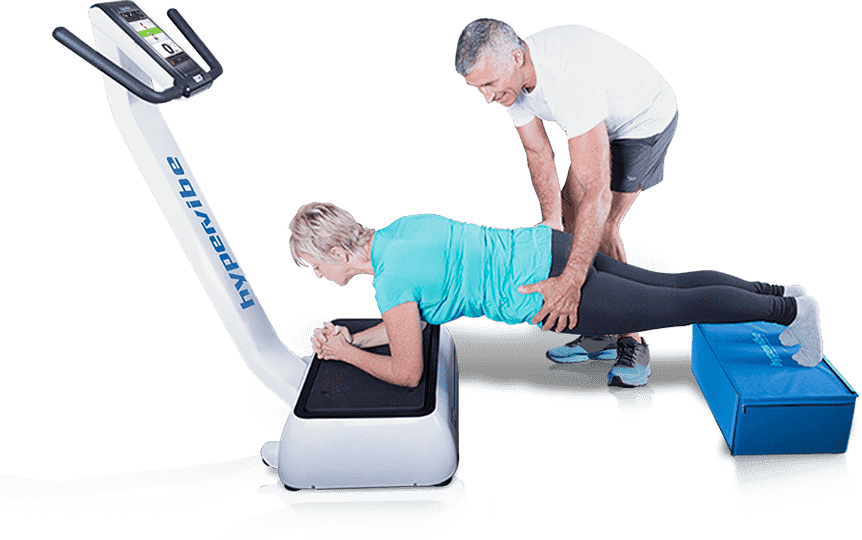
Performing core-strengthening planks on a vibration plate with professional guidance.
At lower intensities, 10 minutes on a Vibration Plate is roughly equivalent to:
This assumes approximately 3–4 METs for mixed vibration activity.
| Activity | 20 mins | Typical Calories (70–75 kg) |
| Vibration plate (static) | Low effort | ~55–85 kcal |
| Vibration plate (active) | Moderate-Hard | ~120–250 kcal |
| Brisk walking | Steady | ~90–120 kcal |
| Easy cycling | Light | ~120–160 kcal |
A 30-minute low intensity, dynamic Vibration Plate session can equal approximately:
This makes vibration training a useful option for people tracking daily steps who need a low-impact alternative.
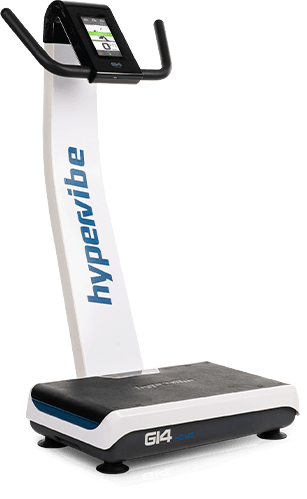
Hypervibe G14 Home V3

 £2,332.50
Shop Now
£2,332.50
Shop Now
Active exercises consistently produce the highest calorie burn on a vibration plate because they combine vibration with voluntary muscle work.
When you add movement:
Examples by intensity tier (commonly used in Hypervibe protocols):
The Hypervibe calories burned calculator uses the same MET-based logic found in widely accepted exercise calorie calculators.
In simple terms, calorie burn is estimated using this relationship:
Calories burned = body weight × exercise intensity × time
A MET represents how much energy your body uses compared to resting.
For example:
Based on vibration-specific benchmarks and how vibration is treated in mainstream calorie databases, typical MET ranges look like this:
Standing quietly on the Vibration Plate sits at the lower end. Adding squats, lunges, and pushups pushes MET values higher by increasing muscular and stabilisation demand.
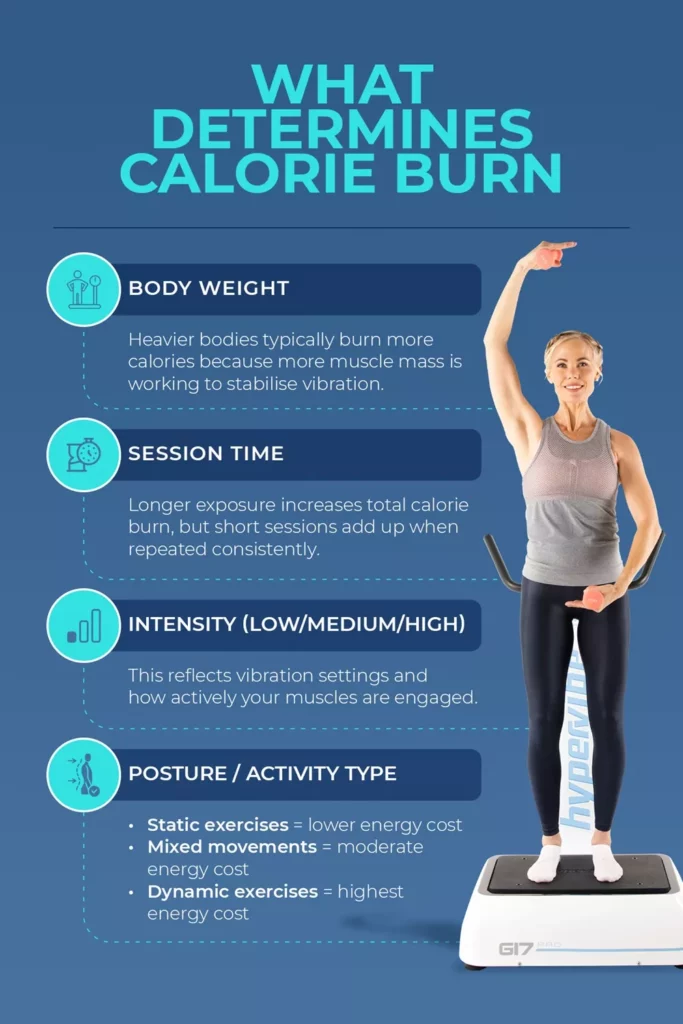
Key factors that determine how many calories you burn during a vibration plate workout.
Changing posture often has a bigger impact on calorie burn than changing vibration settings alone.
The honest answer: it’s good for ballpark estimates, not lab-grade precision.
Like all non-laboratory calorie tools:
That said, it’s accurate enough for planning and comparison—especially when used consistently.
Best practice tip:
Use the calculator alongside:
This provides a clearer picture of progress than calories alone.
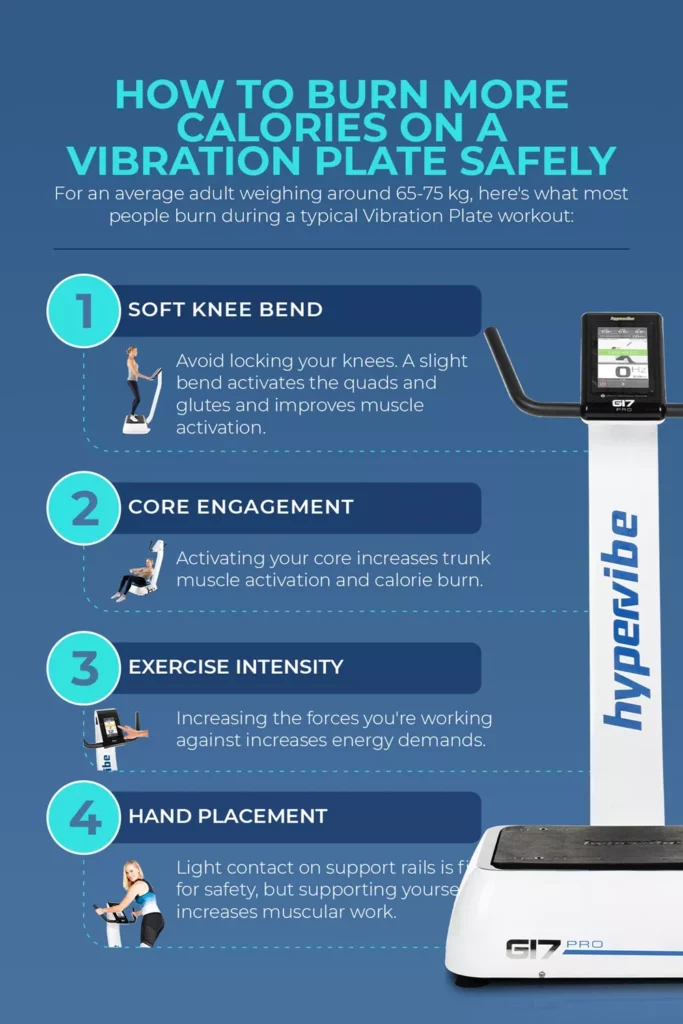
Posture and technique adjustments designed for effective and safe vibration training.
It’s important to pay attention to how you position your body, which exercises you choose, and how you structure sessions over the week.
The tips below focus on increasing muscular engagement while keeping joints protected.
Small posture changes can significantly raise energy expenditure by increasing stabilisation demand:
Each routine below uses short time blocks and sensible intensity ranges.
Calories are estimates, use the calculator above to personalise results.
Goal: consistency and safe progression
Goal: low impact, confidence, circulation
Goal: add calorie burn without extra joint load
Combining Vibration Sessions with Diet and Other Training
Calorie burn only leads to fat loss when it contributes to a calorie deficit. Vibration plates work best when combined with other simple habits.
Easy weekly stacking examples:
You burn more calories on a vibration plate by:
While whole-body vibration is widely used in fitness, rehabilitation, and clinical settings, it isn’t appropriate for everyone without guidance.
You should consult a healthcare professional before using vibration training if you have:
Hypervibe G17 Pro V2
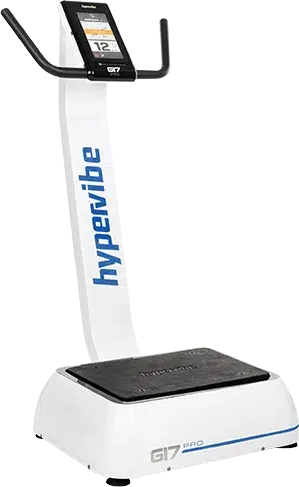
£3,207.50
Shop Now
A Hypervibe plate makes sense if you’re looking for efficient, low-impact movement that fits into real life—rather than long, high-stress workouts.
It’s a strong option for:
Hypervibe systems are designed to support static, modified, and dynamic exercises, allowing users to progress safely while still increasing energy expenditure over time.
Hypervibe uses pivotal vibration, meaning the platform moves evenly up and down rather than straight up and down..
Why this matters:
Rather than locking users into one “hard” setting, Hypervibe platforms offer a broad frequency range.
This allows:
From a calorie perspective, this supports progressive overload—increasing energy demand gradually without forcing you into unsafe intensity jumps.
Calorie burn increases most when users perform dynamic, multi-joint movements. Hypervibe platforms are built with a solid, stable base, making exercises like squats, lunges, planks, and push-up variations feel controlled rather than shaky.
This stability:
In practice, this means users are more likely to reach the upper end of realistic calorie ranges shown in the calculator.
Hypervibe systems are designed so users can:
For most adults, calorie burn depends on body weight, intensity, and movement. As a general guide: Standing sits at the lower end, while active exercises like squats or planks push results higher. Yes, vibration plates do burn calories—but not in a “too good to be true” way. Whole-body vibration increases muscle activation and stabilisation effort compared to standing still, which raises energy expenditure. However, it doesn’t outperform traditional cardio. Yes, you burn calories standing on a vibration plate, but the amount depends on intensity. Static exercises increase calorie burn slightly above general exercise because your muscles are constantly stabilising. Meaningful calorie burn comes from adding movement. Calorie estimates are based on body weight × intensity (METs) × time. The calculator above uses this same MET-based approach found in mainstream calorie tools, adjusted for vibration plate use. Enter your weight, session length, intensity, and posture to get a personalised range. They’re accurate for ballpark estimates, not lab-grade measurements. Like all calorie calculators, they can’t account for individual muscle efficiency or day-to-day variation. They’re best used to compare sessions and track trends over time, not to fixate on exact numbers. Any Hypervibe platform can support calorie burn—the key factor is how you use it. Models that allow stable active exercises, clear intensity control, and progressive programming make it easier to reach higher calorie ranges safely. Movement and consistency matter more than the specific model.
FAQs
- How many calories do you burn on a vibration plate in 10, 20, and 30 minutes?
- Do vibration plates really burn calories, or is that just marketing hype?
- Do you burn calories just standing on a vibration plate?
- How do I calculate how many calories I burn on a vibration plate?
- How accurate are vibration plate calories burned calculators?
- Which Hypervibe model is best if my main goal is burning calories?
Next step:
Use the calculator above, then pick a routine that matches your goal and starting point.


The worst foods for someone looking to maintain a healthy...
Vibration Plates—used for Whole Body Vibration (WBV) or Vibration Training—can...
This article breaks down how many calories you can realistically...
The best fitness equipment for the low back includes back/lumbar...
Whole body vibration exercises may not seem the safest choice...
In order to keep your balance while standing on the moving plate, your muscles have to alternate between being tense...

They come in many colors and sizes and whether you call them Swiss balls, balance balls or exercise balls, one...
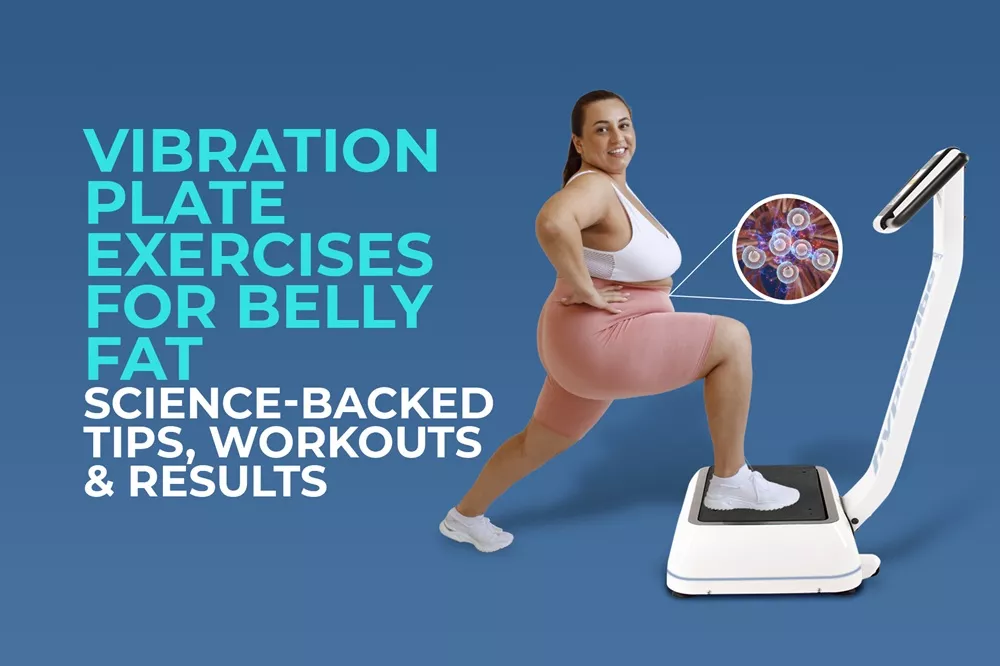
Vibration Plates—used for Whole Body Vibration (WBV) or Vibration Training—can help reduce overall body fat (including belly fat) when you...
With so many different types of vibration plates on the market for home use, your head might spin (or shake!)....
Can vibration machine exercises support weight loss? It’s one of the most frequent questions clients ask before buying a whole...
Since NASA introduced them for mass use back in the 1960s, the vibration plates have been benefiting our health in...
The worst foods for someone looking to maintain a healthy...
Vibration Plates—used for Whole Body Vibration (WBV) or Vibration Training—can...
This article breaks down how many calories you can realistically...
The best fitness equipment for the low back includes back/lumbar...

Whole body vibration exercises may not seem the safest choice...