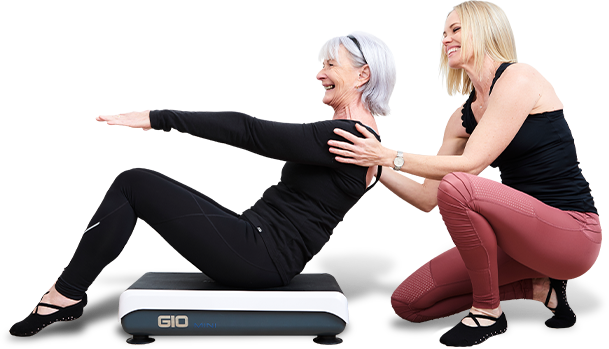

$1,799.00
Shop Now
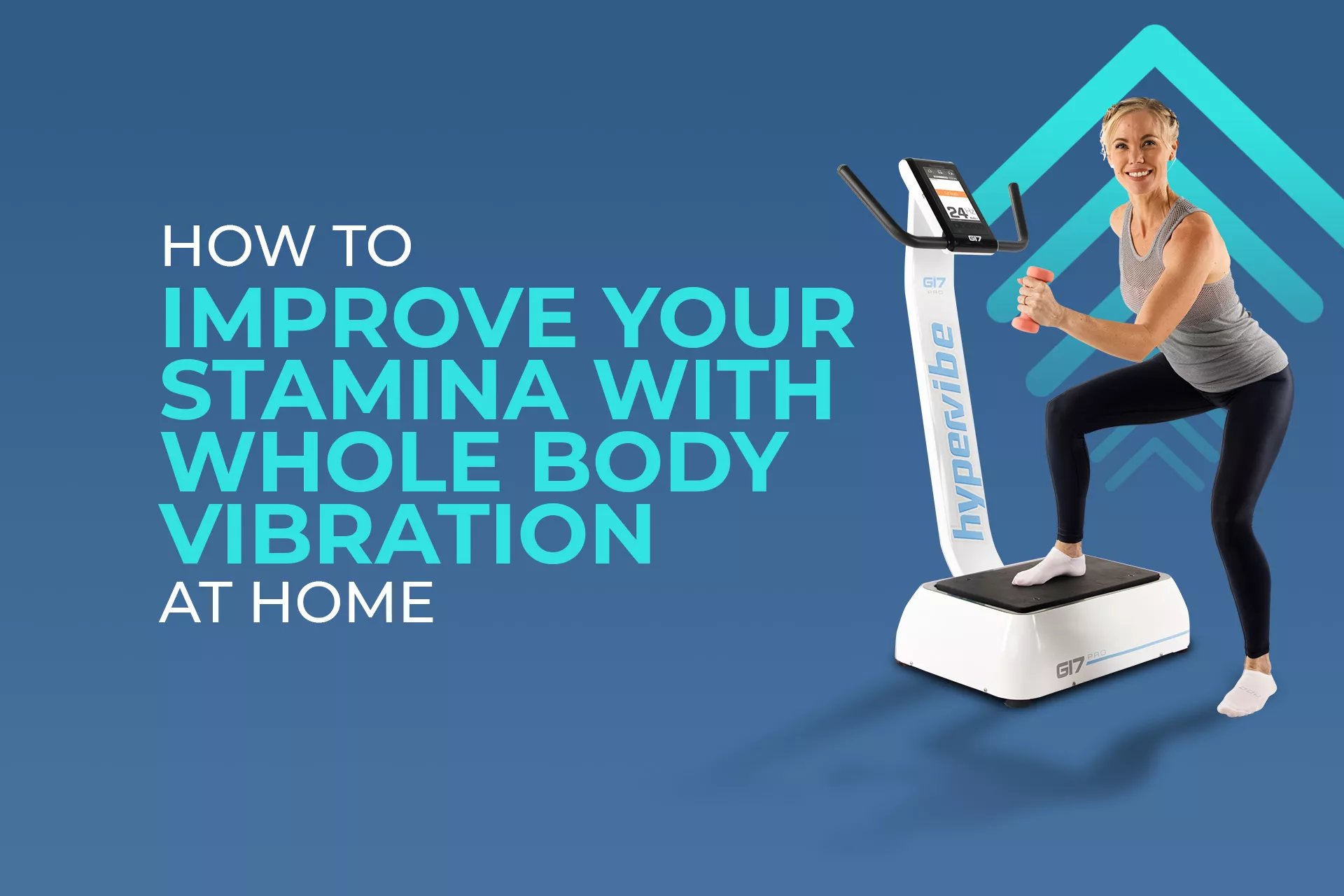
Stamina is a combination of your cardiovascular, muscle, and cognitive system performance.
Research suggests that regular Whole Body Vibration (WBV) training can safely boost muscle strength and cardiovascular system performance and ease tension in the body.
Vibration Training causes your muscles to contract reflexively dozens of times per second, stimulating your cardiovascular system, challenging the muscles of your body, and encouraging mental focus.
Practically, you can improve stamina by doing brief WBV intervals (multiple 30–60 second bursts of exercise with short rests in-between) 2-4 times per week, combined with traditional resistance exercise or cardio on non-vibration days.
Over time, this helps your heart, lungs, and muscles handle more activity with less fatigue.
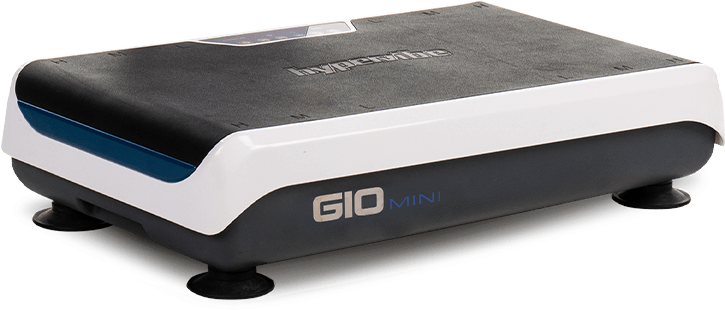


There are many different options for boosting stamina, but a Whole Body Vibration (WBV) platform, like a Hypervibe Vibration Plate, stands out.
It’s a fitness machine that you can stand, sit, or exercise on.
While you do, the platform vibrates underneath you.
Used correctly, it’s designed to help you boost stamina through short, impactful, safe sessions at home, building both strength and endurance and mindfulness without long, challenging, exhausting workouts.
You’ll see different names for the same tool: Vibration Plate, WBV platform, and Whole Body Vibration machine; they all refer to the same thing.
Vibration Training is a technique that uses mechanical vibration to stimulate muscle contractions, thereby increasing strength and bone density and supporting weight loss goals.
The vibration is delivered through a platform that moves up and down at various frequencies and amplitudes.
These combinations result in what’s called G-force.
The higher the G-forces, the more your body engages, and the greater the potential benefits.
Besides the benefits mentioned above, Vibration Training can enhance mobility/flexibility, improve lymphatic function and circulatory system health, aid in mindfulness, and improve balance.
This method has gained popularity due to its efficiency and ability to target multiple muscle groups in a short period of time.
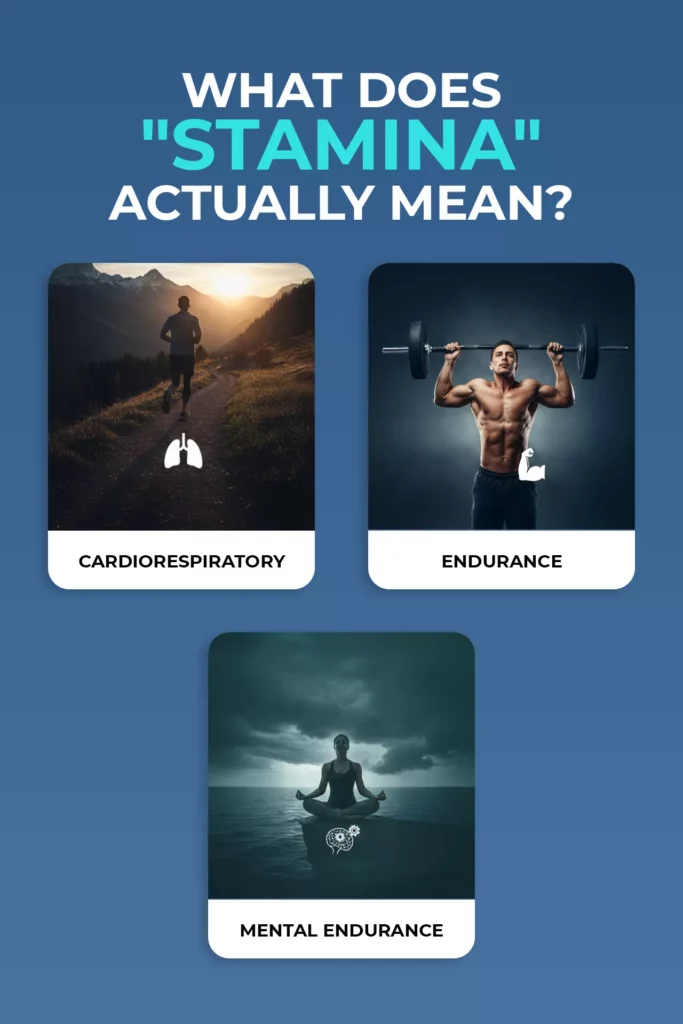
Stamina broken down into cardiorespiratory fitness, muscular endurance, and mental endurance.
When you use Whole Body Vibration for stamina, you’re not just chasing a bigger step count—you’re targeting three related types of endurance:
All three are a big part of staying consistent with any full spectrum stamina plan.
What does the research say?
Current evidence suggests WBV can support stamina mostly by improving the pieces that support it.
Regular WBV sessions, especially for the legs,
can increase muscular strength and power when used consistently over weeks alongside simple strength exercises (like squats, step-ups, or calf raises on the plate).
Several studies suggest that whole body vibration can support cardiorespiratory endurance when it’s used regularly alongside exercise.
In a 1-year randomized trial in adults over 60, WBV training led to significant improvements in peak oxygen uptake (VO₂peak)—a lab measure of aerobic capacity—as well as leg strength, compared with a control fitness program.
In people with chronic lung and heart conditions, adding WBV to standard rehab has been shown to improve 6-minute walk distance and overall exercise capacity versus rehab alone.
In simple terms, when your heart, lungs, and leg muscles can work more efficiently, everyday activities feel easier and you can stay active longer before you run out of steam.
Several weeks of WBV-based programs have also been linked with reduced fatigue, depression, anxiety, and stress, as well as better sleep quality in different adult groups.
There are also promising studies on WBV effects on depression, anxiety and stress in college students.
Studies also show that adding vibration can change ratings of perceived exertion, how hard exercise feels and fatigue during or after a session.
Additional benefits in research:
Across clinical studies in older adults, people with chronic conditions (like diabetes, obesity, stroke, or fall risk),
and generally deconditioned groups, regular WBV combined with exercise has been linked to:
Whole Body Vibration (WBV) tends to help people looking for a more significant level of stamina in less time (and with less joint stress).
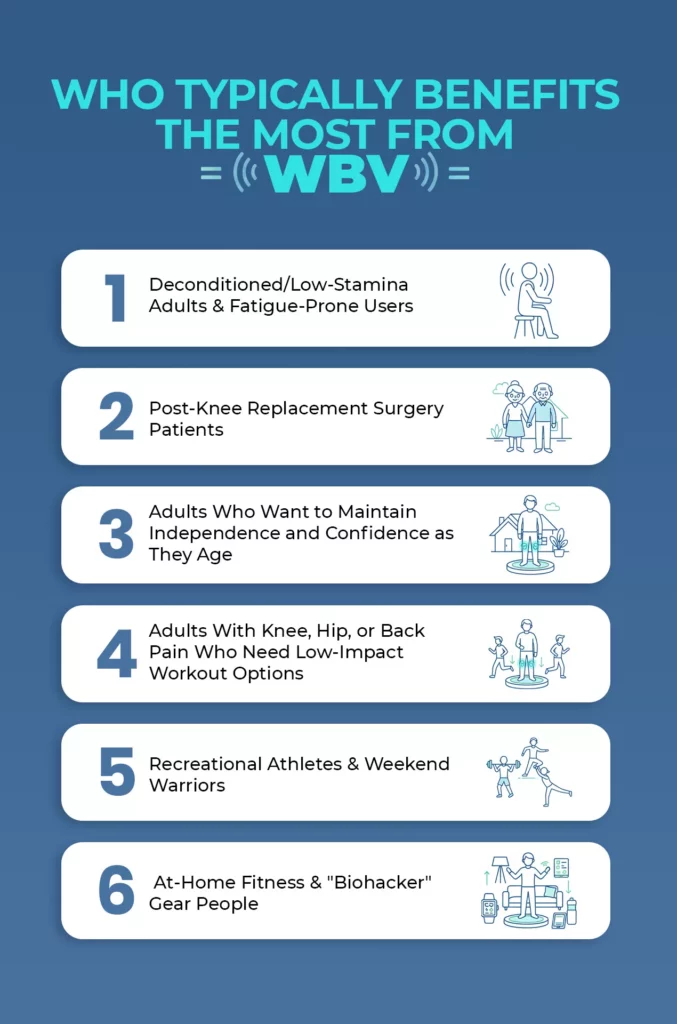
Infographic showing six groups who typically benefit the most from WBV training.
If your schedule is packed, long workouts often just don’t happen.
Short, focused WBV sessions (think 10–15 minutes) can:
For office workers, parents, and busy professionals, a vibration plate at home or in the gym can turn a small time window into a meaningful workout that supports day-to-day increases in stamina.
If you’re someone who feels wiped out by even modest activity (maybe after illness, long periods of inactivity, or if you have chronic fatigue),
WBV offers a way to:
Because the sessions are short and can be done in supported positions, it’s an approachable bridge from “almost no activity” to moving more.
For older adults who are not active people, “stamina” often means something very practical: being able to walk, maintain a healthy heart and breath rate, and stay sharp-minded.
In research with older adults, WBV combined with simple exercises has been linked to:
Those changes translate into real-life confidence: less fear of falling, better cardiovascular health, improved mental resilience, more freedom to get around, and the energy to stay engaged in daily activities.
High-impact workouts like running or jumping can be a non-starter if your joints are irritated or already sensitive.
WBV can help these users by:
Over time, that combination of low-impact loading, circulation, and confidence can make it easier to build both physical and mental endurance for daily life.
Runners, lifters, and “weekend athletes” often use WBV as an add-on rather than a replacement for their main training.
For this group, WBV can:
Over time, that combination—better strength, better recovery, and less joint stress—can indirectly support cardio endurance and the ability to handle more consistent training.
There’s a growing group of people who love stacking tools—standing desks, cold plunges, wearables, and yes, WBV plates.
For these at-home fitness and “biohacker” users, WBV is attractive because:
For this group it’s less about chasing a single metric and more about building a stacked, convenient routine they can actually stick to.
Physiotherapists, exercise physiologists, and rehab-focused doctors most often look at WBV as a clinical tool, not just a fitness gadget.
In hospitals and clinics, WBV has been studied in:
When it’s paired with supervised exercise, studies report:
For clinicians, the appeal is that WBV can help patients who can’t yet tolerate longer or more intense sessions get a meaningful cardiorespiratory training effect in a short, controlled dose.
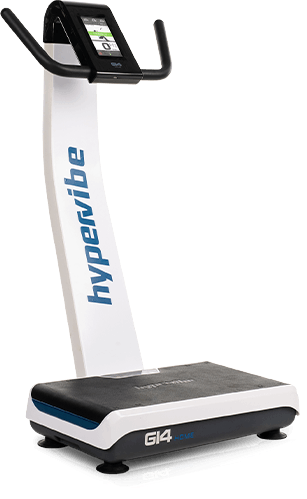


If you’re wondering how to use a Vibration Plate to increase stamina, the good news is you don’t need hour-long sessions.
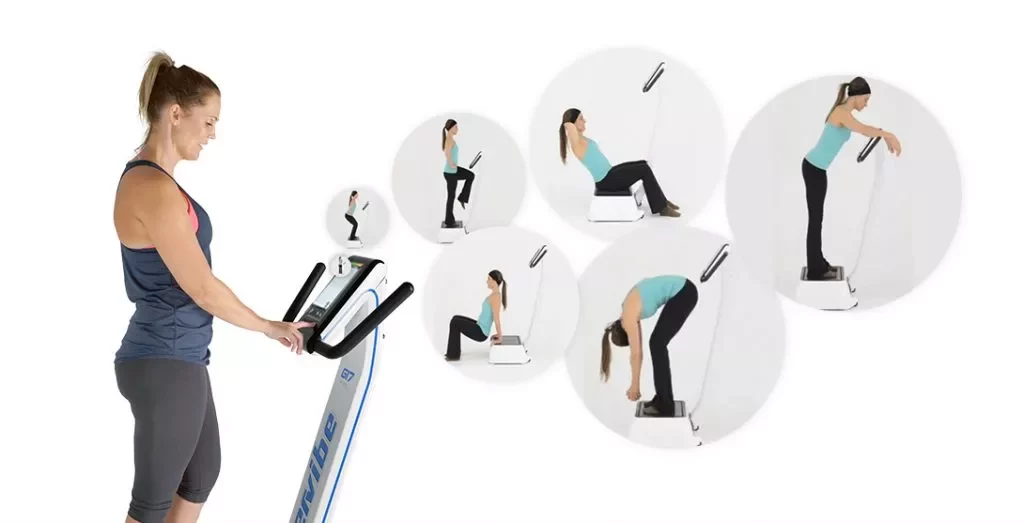
A woman uses a Hypervibe whole body vibration machine, with callouts showing different exercise positions.
Pick the protocol that matches your current reality; each plan is 10–20 minutes and scales up slowly.
Research on WBV and endurance typically uses 2–3 sessions per week over 8–20 weeks, combining the plate with cardio and mindfulness.
Below are evidence-informed, home-friendly protocols: a beginner Vibration Plate workout for stamina, a time-efficient routine for busy people, and a higher-intensity option for those looking to go further.
Goal: Finish the workday with a bit more energy—without needing a 45-minute workout.
Too wiped out for this? Start with 5-minute “stand-only” days—just the warm-up stance and a short cool-down.
Once that feels easy, add a couple of shallow squats or calf raises.
Goal: Build stamina and leg strength in a way that’s kind to sore joints.
Progression
Goal: Use WBV to support elevated stamina.
Suggested settings:
Example structure (15–20 minutes)
This primes lower-body muscles and the nervous system for the rest of the session.
Rotate through 30–45 second blocks with 15–30 seconds rest:
Do 2–3 rounds of this mini-circuit depending on your total time.
The real question is, “Can I get fitter without pounding my joints?”
Woman jogging on a quiet, tree-lined road to build stamina and fitness.
Short answer: Yes, Whole Body Vibration (WBV) works for low-impact strength training.
Running has a high impact.
It’s a great stimulus for healthy joints, but it’s tough if you have knee, hip, or back pain or carry extra weight.
WBV is low impact.
You’re usually standing or doing movements on the plate, so you load muscles and bones without the pounding of running.
That’s why WBV shows up a lot in rehab and hospital programs for older adults and people with chronic conditions.
Running, brisk walking, cycling, and swimming are true aerobic exercises—they’re still the main drivers of big VO₂max and heart-health gains.
WBV mainly boosts cardiorespiratory capacity, leg strength, balance, and muscular endurance, and in some studies, improves walking tests and fatigue ratings.
WBV is an important addition to your workouts that makes cardio easier and more sustainable, especially if you can’t tolerate long or intense workouts.
Yes, you can build stamina without ever running if you’re consistent.
Follow any of the above programs for a “no-running protocol.
You don’t have to run to get fit—but you do need regular movement and gradual progression.
WBV simply makes that journey kinder on your joints and easier to stick with.
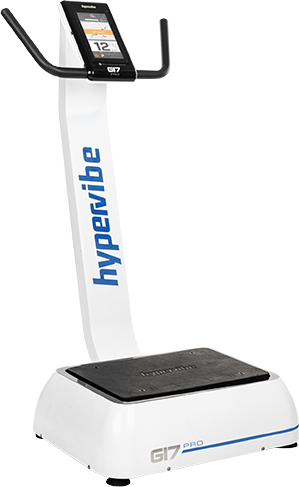
If you want to use Whole Body Vibration (WBV) to actually train stamina, not just “stand and hope,” the details of the machine matter: frequency range, G-force, stability, and programming all change how safely and precisely you can follow a stamina plan—especially if you have joint issues.
Hypervibe platforms are built around research-style variables (controllable frequency, amplitude, and G-force), with side-alternating motion and validated specs of 5–35 Hz and up to ~17 g on the G17 Pro.
Many cheap “stamina boosting” plates don’t publish real specs, can’t reach the ranges used in most WBV studies, or only give you vague “speed levels.”
Controlled frequency range
G-force and exercise load
Stability & handholds
Programming & guidance
In short: Hypervibe lets you train stamina using known, research-aligned settings, while most low-cost plates leave you guessing.
|
Feature |
Hypervibe (G-Series) |
Generic Low-Cost Plates |
Power Plate/Other Premium Plates |
|
Stability & Rails |
Sturdy side-alternating platforms with high user-weight limits; full-size units include handrails for balance. |
Small, light, and often wobbly; usually no rails, and stability is a common complaint. |
Sturdy, vertical platforms, and optional rails depending on the model. |
|
Frequency and G-force |
5-35 Hz side-alternating, up to ~17 g, covering low-mid ranges used in many circulation/strength/endurance studies. |
Often <15 Hz or unclear specs; many can’t reach research-style ranges and deliver relatively low G-force. |
25-50 Hz with multiple amplitudes and strong training stimulus for sports and rehab. |
|
Evidence-based programming |
Pivotal machine, which is the most researched platform. |
Basic “P1/P2/P3” presets with no clear rationale or validated intensity data. |
Vertical setting that are highly researched. |
|
Fit for seniors, joint pain & stamina protocols |
Low-frequency options, rails, and clear programs suited to gentle stamina work and joint-sensitive users. |
Often too unstable or imprecise; lack of rails/known intensity makes safe, precise stamina protocols difficult. |
Good under professional supervision; starting frequencies (~25 Hz) can feel intense for very deconditioned users. |
According to clinical insights and leading fitness studies, Vibration Training should be avoided by individuals with a number of conditions.
The most common ones are:
If you’re unsure, speak with your healthcare provider before starting a Vibration Training program.
Before you start, take note of the following tips to ensure your safety.
They eventually talked me into trying Hypervibe and now I’m hooked.
I’ve lost 32 lbs (14.5 kg), got the feeling back in my hand and can play with my grandkids again. I feel 20 years younger.
– Alan, Happy Customer
I was determined to deal with my bone density issues safely and naturally so I turned to Vibration Training.
After 2 years of Hypervibe, my bone density increased 8.3% — I was astonished.
– Cydya, CBSNY TV Show USA
The simplest way to use Whole Body Vibration (WBV) for stamina training at home is to start with 10–15 minutes, three to four days per week using a low-to-moderate setting.
Stand in a soft-knee stance and add basic moves like mini-squats, calf raises, and glute bridges with short holds as you feel comfortable.
Over time, you can slowly increase time, difficulty, or frequency every one to two weeks.
Most people don’t feel a huge difference in week one—stamina changes are gradual.
With consistent Whole Body Vibration (WBV) sessions plus cardio, many notice easier stairs, less leg fatigue, or quicker recovery within four to eight weeks. Also, mindfulness effects can be readily achieved.
Your starting fitness, age, and health conditions will influence how fast you notice results.
Yes, you can often use WBV on “low-energy” days, but treat it as a light session, not a test of willpower.
Short, low-intensity sessions (five to 10 minutes, gentle stance) can boost circulation and loosen stiff muscles without draining you.
If your fatigue is from illness, very poor sleep, or overtraining, rest or talk with your healthcare provider first.
Whole Body Vibration (WBV) can be used in some people with high blood pressure or diabetes, and there’s research on WBV as a support tool in these groups—but it must be done carefully and with medical guidance.
WBV is best viewed as a support tool, not a full replacement for all cardio.
It can help you build strength, endurance, and functional capacity so that walking, cycling, or other aerobic exercise feels easier.
For long-term heart and lung health, most people do best combining Whole Body Vibration with regular walking or other moderate-intensity cardio.
Your Vibration Plate settings are probably too strong if you feel numbness, joint pain, dizziness, or headaches, or if you have to tense your whole body just to stay on the platform.
A good WBV stamina session should feel challenging but controlled: you can breathe normally, keep good posture, and hold a short conversation if needed
If in doubt, lower the intensity and shorten your sessions until it feels comfortably demanding.
If your goal is improving stamina, the machine’s frequency range, G-force, and build quality are important.
Hypervibe platforms are engineered to reach evidence-based WBV settings used in research, with side-alternating motion, rehab-friendly low starting settings, and solid frames designed for regular, progressive use.
Many low-cost plates can’t reliably hit or maintain these ranges or feel unstable when you try to do real exercises on them.
“I’m exhausted and out of shape.”
If stairs, groceries, or short walks leave you wiped out.
“I’m active but my joints complain.”
Maybe you walk, jog, or work out—but your knees, hips, or back protest if you push too hard.
“I’m an athlete or biohacker.”
If you already train regularly and want better work capacity, recovery, or performance, use a performance optimization plan.
If any of these describe you, Whole Body Vibration is a great addition to your health and wellness routine.
Download the Hypervibe Buyers Guide and take a look at our G-series models.
Here’s how we use a vibration plate for weight loss...

If, a few minutes into your session on the vibration...
Are vibration machines bad for you? Yes, if used incorrectly....
Yes, Vibration Plates or Whole Body Vibration (WBV) platforms, promote...
Most people get the best results using a vibration plate...

If you smoke, suffer from diabetes or are overweight and have elevated cholesterol levels, you're more likely to develop high...
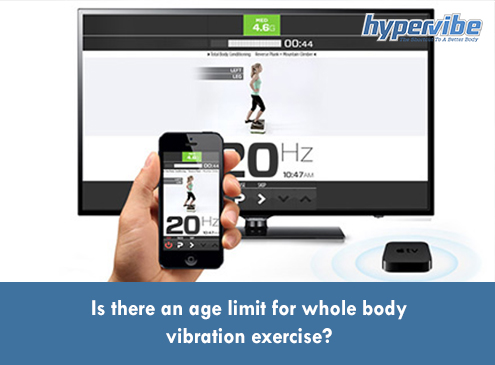
Exercising has no age limit, but is age-specific, meaning that some types of exercise are more recommended for people in...
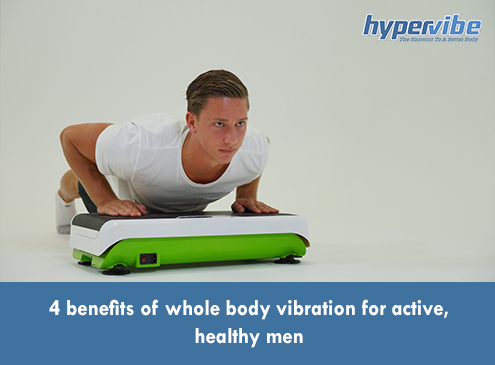
Young, active men are more likely to choose strength training, weight lifting and sports activities instead of whole body vibration...
Most of us aim to maintain a healthy body weight, as we know it can have a major impact on...
To stay safe and avoid injuries while exercising on your Hypervibe whole body vibration machine, you should get familiar with...
In a previous article we've discussed the long-term effects of whole body vibration on the human body, and showed that...
Here’s how we use a vibration plate for weight loss...
If, a few minutes into your session on the vibration...
Are vibration machines bad for you? Yes, if used incorrectly....
Yes, Vibration Plates or Whole Body Vibration (WBV) platforms, promote...
Most people get the best results using a vibration plate...